The Bastide Towns
In the Middle Ages, the Duchy of Aquitaine was a possession of the
English crown, and the region faced constant conflict between the
English and the French, notably in the Hundred Years War. Both sides
took to founding new towns -- the bastides --to secure the economy of
their territories, and these typically followed a common design of a
grid of streets centred on an arcaded square. Often, the square would have had an
open-sided market hall, but few of these have survived.
The best-preserved bastide is Monpazier, founded by Edward I of
England, but there are many others to visit, all with their own
variations -- good or bad. The burghers of St. Foy le Grand, for
example, had the poor taste to fill their town square entirely with the
building of the town hall, or mairie, some time in the nineteenth Century, I guess.
One town I found particularly pretty was Cordes-sur-Ciel (yes, Cordes-in-the-sky),
possibly not strictly a bastide, because its hilltop situation makes
the usual grid pattern impossible, but it must have been a rich little
place in the Middle Ages to judge by the fine buildings; and its
situation is just magnificent.
On the Rocks
The rugged landscape gave the inhabitants plenty of opportunity for
defensive architecture. The improbably cute La Rocque Gageac clings to
the base of a cliff on the Dordogne River, and ancient pathways snake
up the cliff to galleries and fortifications.
Rocamadour is another site that takes advantage of the cliffs and steep
valleys. It's a site of pilgrimage: either for the mysterious Black
Madonna, or because the preserved body of St. Amadour was discovered
there in the twelfth Century. I like the theory that Europe's Black
Madonna icons, many with links to the Roma (Gypsies), are actually
depictions of Hindu goddess Kali.
The religious and military buildings spill down the cliff face, and the
old town straggles along the valley floor below. Conveniently for
modern visitors, a series of cable cars and elevators link the high and
the low.
Biarritz and Bayonne
My final destination in France was back to the Atlantic coast at
Biarritz and Bayonne. The two towns more-or-less merge into one
another, but I'd heard that Bayone was the more cultured and less brash
half of the partnership, so I booked my accommodation there.
Unfortunately, I didn't take sufficient care in selecting a hotel and
picked one in an edge-of-town, motorway-exit position, which was not
very convenient.
By the time I arrived, the weather had broken, but the local edition of
the free news sheet told the tale of the times I had missed. "The
sweetness of the Indian Summer", it says.
The article begins, "Quand on vient on vacances ici pour Toussaint,
faut pas oublier son maillot de bain", s'exclaime, ravie, Emilie. En
bikini, la jeune étudiante bordelaise sort de
l'Océan en éclaboussant ses copines, qui ont
gardé le bronzage du mois d'août. It isn't clear which young lady in the picture is Emilie, but her swimsuit clearly doesn't take up much room in her suitcase.
And there wasn't much splashing in the ocean or working on the suntans when
I arrived. After a minute's exposure to the Atlantic breeze, I had to
return to the car to get my fur-lined jacket.
Biarritz once had a reputation as a playground of the wealthy - hence
the grand art-deco casino, now too-perfectly restored. However, now it
seems to be a playground of the common people, which is very worthy,
but quite dull. My favourite part of the town is the old harbour area,
which was a real haven from the Atlantic waves on my visit.
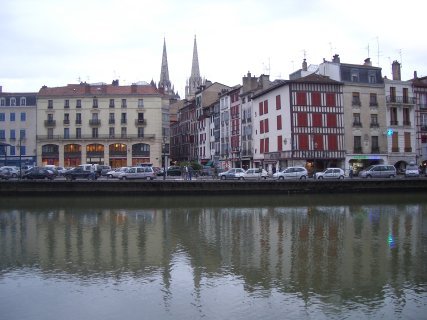
As predicted, Bayonne has a different feel to it. These days, I'd say
"faded gentility", although the main shopping areas still host all the
big names in fashion and accessories. The town definitely has a lot
more character than its seaside neighbour.
One thing I found interesting, given the "Centralist" nature of France,
was that many of the roadsigns in the area are tri-lingual:
French, Basque and Gascon. (Some people call Gascon a dialect of Occitan, some say it's a separate language:
usually it was identical or almost identical to the French spelling. Basque [Euskadi] is
unmistakeable, being -- literally -- like nothing else on Earth.)